


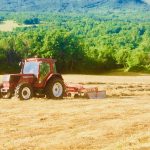

Seeing the fact that we grow heritage wheat in Italy, and my love affair with Durum wheat (hopefully touch on that in a series of blog entries) I am more aware of Italian landraces, of which my preferred Durum is Timmilia but we would touch on that later. I have recently been visited by two friends from Israel, who are both great cooks. I have become an expert on old and traditional pastas, which made from heritage wheats combined with old recipes have got some renown, so when we have visitors I rarely get to learn new recipes.
This time I insisted that they cook and teach me a recipe, they taught me how to make Kibbeh which is a bulgar wheat dumpling filled traditionally with meat and onions, even though they used a vegetarian alternative of mushrooms onions and a little touch of dates. The recipe called for Bulgar wheat obviously, which we did not have, but seeing our larder is full of sacks of Italian and Palestinian landraces, I suggested we simply use the mill and make some cracked wheat.
To be honest I was very unfamiliar with Bulgar until that point, in fact I totally ignored other culture uses for Durum wheat focusing on Italian breads and pasta, which I have to admit was short sighted, because in truth North African, Iraqi, Syrian and Turkish recipes are a cupboard full of amazing uses for Durum wheat, which I always championed. Because we had little time that day we hurried through the process and used cracked wheat instead of Bulgar wheat. A week later after they left, I decided that I want to see if I understood the recipe first, but more importantly learn how to make Bulgar wheat at home.
Sometimes when we are discovering a new recipe or in that case a whole new cuisine, we like to turn it into a voyage, where we also go and find all the ingredients using local farmers, because you can promote rural generation as much as you like, and for with traditional foods, but using that to help local farmers, and better still homesteaders is as important. We found a new source for local lamb, which turned out does meat boxes once a month, so we decided to make a non vegetarian Kibbeh, and use the opportunity.
There were two versions of making Bulgar at home I could find, one was soaking it for an hour and then drying it in the oven, the other was by boiling it and drying it in the sun, seeing that I actually wanted to understand the principle behind Bulgar, and why it came about, something I think is best done by following the traditional method to understand the logic behind older foods, I opted for boiling. Traditionally this is done on big pots and then left to dry spread on roof tops.

Seeing we were in Wales I put the put on the fire and we went to get the meat. When we came back it was throughly cooked and slightly split, I drained the water, I would have preferred to have dried it in the sun too, but that was in short supply, plus we had the day to get to the final product so I stuck it in the oven.


I used our electric mill to break the now dried again grain, I kept it a little moist because I figured it was silly to boil it, dry it and then soak it again for the Kibbeh, so I just dried as much as I thought the mill could deal with without making it into a paste on the stone.
Unknown to most although heritage wheats are all healthier then modern, and Durum was always considered the best grain in ancient times, possibly because of its nutty taste, and high protein content, some landrace wheat does have affect on our bodies which was for years confused for gluten intolerance, where in fact it is probably an anti immune response to the gliadins, I would not go into this in detail because I do not totally understand it all, or rather I am developing my conclusions but those mean experimenting with many landrace wheat and mixing a lot of emmer into our diet. In any case, I bring it up because I thought that it is strange a people came up with a means to preserve their grain and use it but it seemed long winded, even though it was obviously a genius way especially as it means you can eat your grains without needing to mill them. I thought that maybe by boiling and drying them again some of the effects that landrace wheat has on some people was also counteracted, but like I said I do not totally understand it, and have only myself to experiment on.
I would leave putting the recipe for Kibbeh here because although I believe I made some of the nicest Bulgar, I only made it a few times. The recipe is for a lemony mangold soup with turmeric which is an amazing contrast for the Durum/Bulgar dumplings filled with lamb. I have used an Israeli/Palestinian landrace called Beit Fata which was collected and later grown by a friend of mine from a handful of seeds. I have grown those in Italy under the belief that the older and closer to the source you get the better the taste is, looking for the oldest landraces of Durum, possibly one that originates from the Jordan Valley where I grew up, unfortunately the Durums I got from Israel did not taste as strong as some of the Italian ones. Yet when I made Bulgar out of them they really came through, with a soft and nutty taste.

